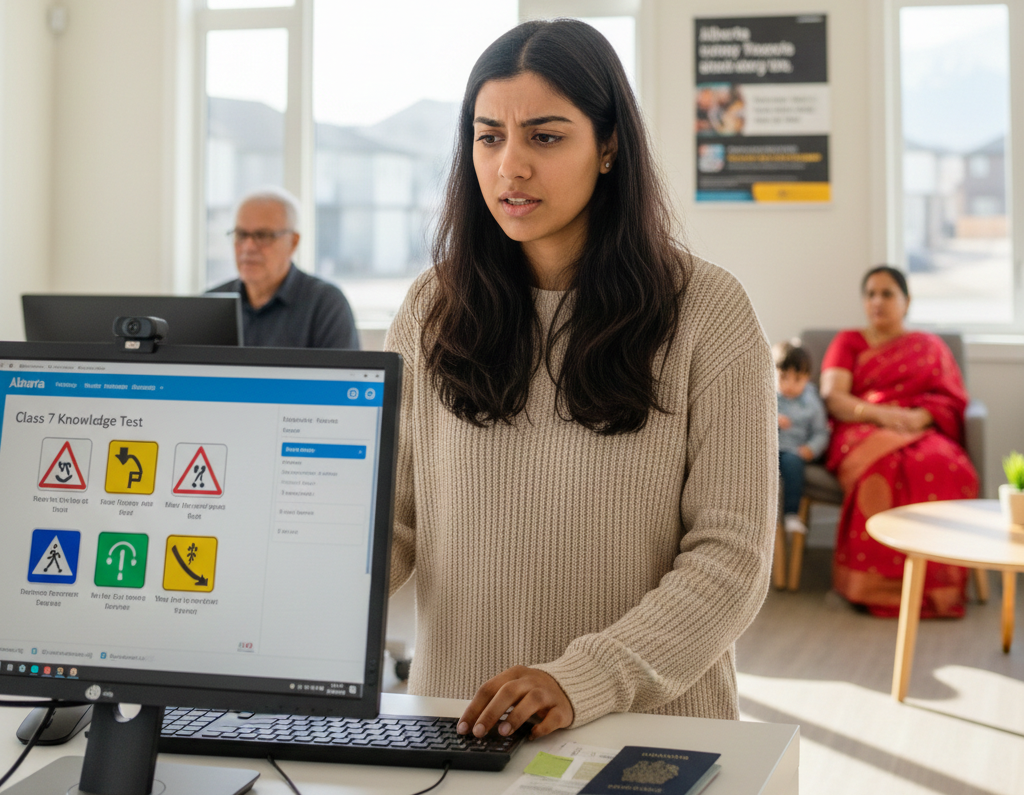
Earning your Class 7 Learner’s License is the first major milestone for anyone looking to drive in Alberta. Whether you have years of experience driving in another country or are starting completely from scratch, the process in Alberta has its own set of rules and quirks.
Having recently navigated this process myself, I wanted to share a practical guide to help you pass your test and get one step closer to your full license. (Note – Download my personal quick study guide I created at the end of the post)
1. Understanding the Class 7 Basics
In Alberta, the Class 7 is a Learner’s License. To get it, you must be at least 14 years old (though most newcomers are adults) and pass a knowledge test and a vision screening.
What you can do with a Class 7:
-
Drive a Class 5 vehicle (standard car/SUV), but only with a fully licensed driver (Class 5 non-GDL) who is 18 or older sitting in the front passenger seat.
-
Drive a moped.
2. Step 1: Study the Right Material
Don’t try to “common sense” your way through this test. Alberta’s road rules, especially regarding four-way stops and traffic circles, can be specific.
-
The Handbook: Download the official Driver’s Guide to Operation, Safety and Licensing. It is available for free online on the Alberta government website.
-
Practice Tests: This is the secret to passing on the first try. Use the Alberta Learner’s Practice Test apps or websites. Keep taking them until you consistently get 100%.
3. Step 2: Gather Your Documents
Before you head to the registry, make sure you have your “Proof of Residency” and “Legal Presence” documents ready. As a newcomer, this usually includes:
-
Your Passport or Permanent Resident (PR) card.
-
Work or Study permit (if applicable).
-
Two pieces of mail showing your current Alberta address (utility bills, bank statements, or even your rental agreement).
4. Step 3: Visit the Registry
In Alberta, driver licensing is handled by private Registry Agents rather than government offices.
-
No Appointment Needed: Most registries allow walk-ins for knowledge tests, but try to go mid-week to avoid the Saturday rush.
-
The Fee: Expect to pay around $17–$20 for the knowledge test itself. If you pass, there is an additional fee (around $90) to issue the actual license card.
5. Taking the Test
The test is conducted on a computer at the registry office. It consists of 30 multiple-choice questions.
-
The Passing Grade: You need to get at least 25 out of 30 correct.
-
No Time Limit: Take your time. Read every question twice. Some questions are phrased trickily to ensure you actually know the law.
-
Languages: The test is available in many languages, including Hindi, Punjabi, Arabic, and Spanish, which is a huge help for newcomers!
6. Tips for Success
-
Focus on Fines and Demerits: Many people fail because they skip the section on “Demerits and Suspensions.” Expect at least a couple of questions on how many points you lose for specific infractions.
-
Vision Test: If you wear glasses or contacts for distance, make sure you have them with you. You will have to look into a machine and identify symbols/colors.
-
Don’t Give Up: If you don’t pass the first time, don’t worry! You can take the test again as early as the next day (though you will have to pay the test fee again).
Final Thoughts
Getting your Class 7 is more than just a permit to drive; in Alberta, it serves as your primary piece of government photo ID. It’s your “entry ticket” to life in Canada, making everything from opening bank accounts to picking up packages much easier.
Good luck with your study! If you have questions about the Calgary registry locations or the study process, feel free to leave a comment below!
Downloadable – Quick Study PDF Guide for Class 7 License preparation